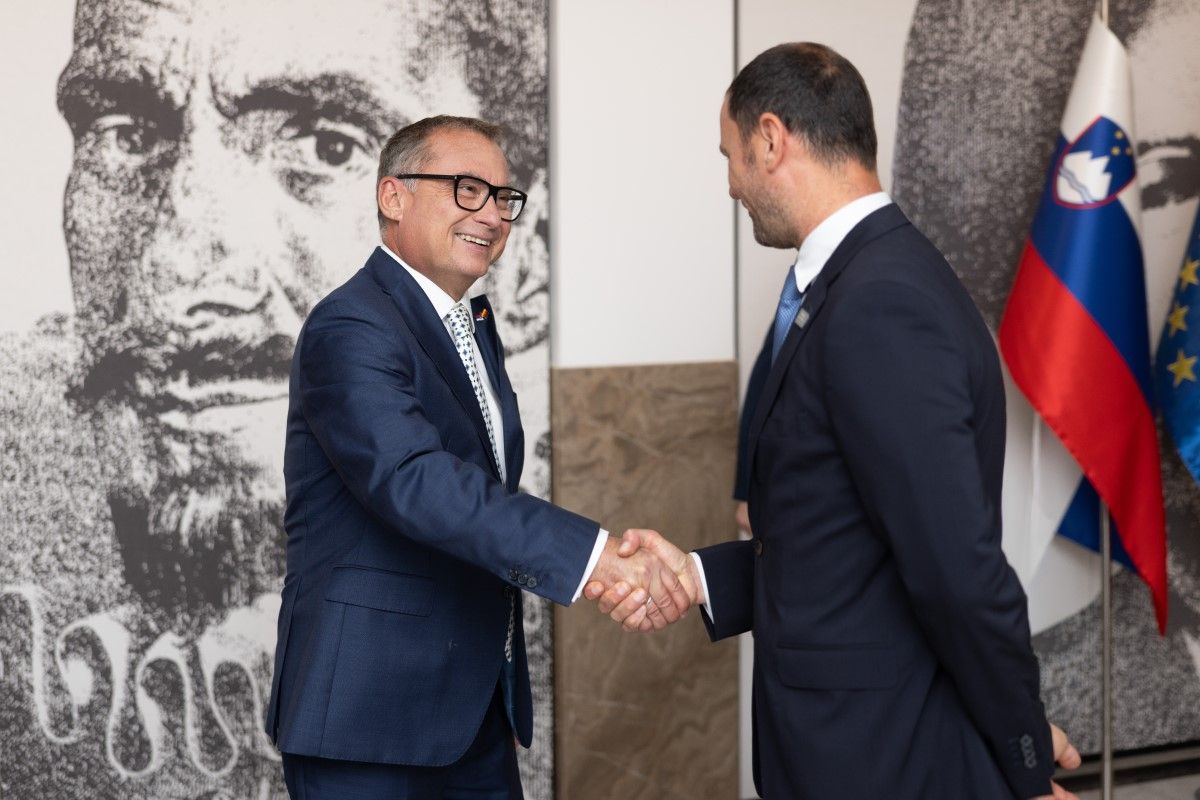
At the invitation of Governor Primož Dolenc, Joachim Nagel, President of the Deutsche Bundesbank, visited Banka Slovenije today for high-level discussions on current economic developments and monetary policy challenges. The meeting provided an opportunity to further strengthen cooperation between the two central banks and exchange views on issues shaping the economic outlook in Europe. As part of his visit, President Nagel also participated in a public roundtable discussion organised by the German Embassy in Ljubljana and the Slovenian-German Chamber of Commerce and Industry.
Joachim Nagel has served as President of the Deutsche Bundesbank since 2022 and has played a key role in shaping the monetary policy of the Eurosystem.
During the meeting with the management of Banka Slovenije, discussions focused on current and long-term economic challenges that central bank governors take into account when making monetary policy decisions. Among the short-term challenges, geopolitical developments featured prominently, while the key long-term structural challenges include the consequences of demographic change, technological progress, and Europe’s dependence on energy resources and critical raw materials.
In the second part of his visit, President Nagel participated in the roundtable discussion Our Economy in Uncertain Times – Can Europe Keep Up?, organised by the German Embassy in Ljubljana and the Slovenian-German Chamber of Commerce and Industry. The participants were welcomed with opening remarks by Sylvia Groneick, Ambassador of the Federal Republic of Germany to Ljubljana.
During an opening discussion with the moderator, President Nagel addressed inflation developments in the euro area and the role of the European Central Bank (ECB) in safeguarding price stability. He also reflected on the effectiveness of central banks in bringing inflation under control and discussed the broader question of whether the ECB should place greater emphasis on supporting economic growth and employment alongside its primary mandate of maintaining price stability.
The discussion was followed by a roundtable featuring the President of the Deutsche Bundesbank, Gabriele Rose, Chair of the Management Board of the Slovenian-German Chamber of Commerce and Industry, and Primož Dolenc, Governor of Banka Slovenije.
Governor Dolenc emphasised that sustained investment in productivity, innovation and economic restructuring is essential for the long-term competitiveness of Slovenia and Europe. He noted that access to financing is currently not the primary constraint for most Slovenian companies. However, a significant financing gap remains for innovative, high-growth and higher-risk projects, highlighting the need for more developed capital markets and greater private risk investment at the European level.
Looking ahead, he identified the completion of the Single Market and the Capital Markets Union as key priorities for the future of the European Union and the euro area. In his view, only a strong and integrated Europe can provide the conditions for businesses to succeed and enable the European market to compete effectively on a global scale.